“Power Fibers” Article

Power Fibers is an on-line magazine of interest to bamboo rod builders. The April 2011 issue just came out, and you can download the .pdf file here. I mention this because I authored one of the articles, “Small Machine Tools for Reel Fabrication”. Classic styled reels like mine are probably of the most interest to people who build/fish with bamboo.

My intent in this article is to show the crafty and artistic rod builders what minimal tools they would have to buy in order to make a reel that superficially resembles those of vom Hofe. I did not consider what tools would be needed to produce reels at a profit, because I don’t know very much about that.

The article is heavy on pictures, but I can find only one slip-up: a picture of some reamers and drills got used twice while one picture was left out. This is my error and not that of the magazine editor. Here is the missing picture.

This goes in at the first occurance of the reamer/drill picture, where a brass arbor is being discussed.

Posted in Articles | Leave a comment

Spool Capacity

When I designed my first reels, I intended to accomodate 5 weight lines. I set the spool capacity from measurements of some other reel, now forgotten. So yesterday I made some measurements on the line that I installed on the prototype reel (same spool size as the later group). This line consists of 162 feet (54 yards) of 20# backing and a 90 foot (30 yard) WF4F.

My reel spools have OD = 2.6 inches, ID = 0.5 inches, and spacing between spool plates of 0.83 inches. So the volume available for line is 4.24 cubic inches.
i.e., volume = pi/4 * (OD*OD – ID*ID) * spacing.

When I had wound up the 162 feet of backing, the diameter was built up to 1.3 inches. So the backing took up 0.94 cubic inches. Then winding on the line brought the diameter up to 2.0 inches. The line volume was 1.51 cubic inches.


At 2.0 inch diameter, there is plenty of room still left on the 2.6 inch diameter spool.

If the line had been 5 weight instead of 4, what would the wound-up diameter be? Typical weights of fly lines are:
3 wt 100 grain
4 wt 120 grain
5 wt 140 grain
6 wt 160 grain
By proportions, a 5 weight line should occupy 1.76 cubic inches, and on my reel the built-up diameter (with same backing) would be 2.1 inches. This would still fit comfortably on the reel.

Update 16 Feb 2012: 54 yards of this backing filled 0.94 cubic inch, so 100 yards would fill 1.74 cubic inches. I don’t really know what brand backing this was; it was something that I stripped off an overfilled reel some years ago. Not really sure now that it wasn’t 30# instead of 20#. Just bought a new 100 yard spool of Scientic Anglers 20# backing, and it fills only 1.10 cubic inch.

Posted in Line/Knots, Spool | Leave a comment

Pawl Wear Test, Higher Speed

My original pawl wear test (post of Nov. 16, 2010 ) used a gearmotor that ran at 20 rpm.  The wear pattern on a pawl showed an impression on the flank of the pawl where each ratchet tooth initially made contact, then abrasion on down to the tip and across the tip.  Because there was abrasion across the tip, the pawl was ground down with time and I could quantitatively compare materials by the amount that the pawl was shortened.

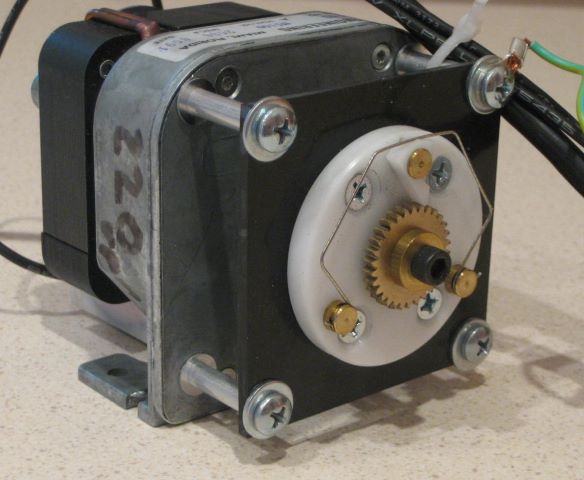
A problem with this test is that reel spools do at times spin much faster than 20 rpm, and this might greatly affect wear.  So I have now obtained a faster gearmotor (220 rpm) and re-run the test with a natural Delrin pawl.  Testing time was 15 hours instead of 7 days, in order to get the same number of contacts on the pawl.

This time the wear pattern was different.  The impact line on the flank of the pawl can still be seen, but there is no abrasion on down the flank and across the tip.  So the pawl shows no wear that I can measure.  Apparently the pawl strikes a ratchet tooth and then rebounds sufficiently that there is no more contact with that tooth.  If testing time were continued, the impact impression would likely become larger and there would eventually be complete failure.  But I think that I will have to use this faster tester for qualitative rather than quantitative comparison of materials.


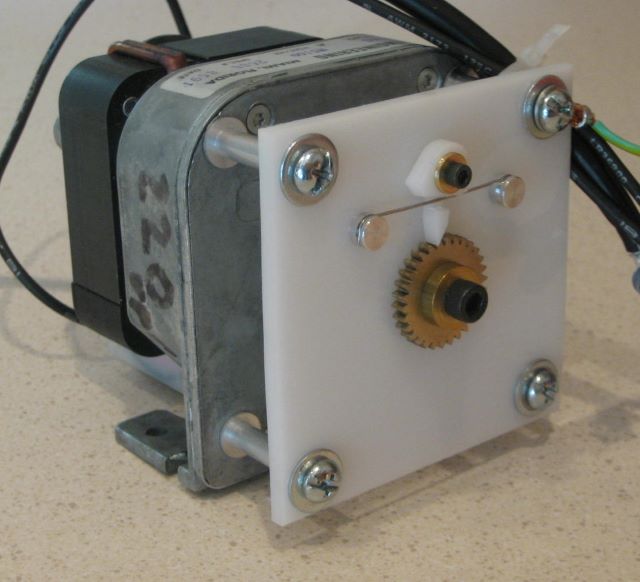
I have also made a fixture (same gearmotor) to allow testing of the new pawl configuration that I am considering.

Where am I going with this?  I am trying to justify the use of a metal pawl (slavery to tradition).  My criteria for a good pawl material are a) corrosion resistance, b) ease of machining, and c) durability.  Obviously plastic is going to win on the first two criteria.  Because I have only tried soft metals, plastic so far wins on the third criteria also.

I have by now been able to machine the new design pawl from 416 stainless, which can be heat treated to improve hardness.  I am also interested in using bronze, which is probably more corrosion resistant than stainless in this application.  There are several bronzes to consider. Expect some future posts on this development.

Posted in Pawl, Testing | 3 Comments

Alternative Pawl Design

Some months ago, the pawl arrangement used by Brent came to my attention . Brent (eotr) is a prolific creator of new reel designs and a regular contributor to Rod and Reel Maker’s Forum.  He is also a very helpful guy. His configuration uses a simple and short spring that appears to have no preload when the pawl is centered. By contrast, the springs in my first reels are preloaded but are more compliant so that the force on the pawl changes little with pawl rotation.  A recent photo of my pawl arrangement is in the April 7, 2011 post to this blog.


I have prototyped something similar to Brent’s design on a gadget that lets me spin the ratchet and examine operation.  So far it seems quite satisfactory in terms of drag.

Posted in Click, Pawl | Leave a comment

Reel Bags

I have just made bags for the group of reels. Got an antelope hide through Ebay; it was nice and soft. Then my close acquaintance who sews was able to cut the pattern and sew 2 sides of the clingy, stretchy material. Finally, I got a hole punch and thong at the local hobby superstore.

Today was a day to take photos, so here are a couple more.

Posted in Bags | 2 Comments

Two Reels Finished

I reduced the anodizing current, so now it is taking 14 hours to plate the parts for 1 reel (7 runs @ 2 hours). Finally got enough parts done to assemble two reels.

These two have identical spools, but the raised pillar reel appears to be much smaller.

Update 4 April 2011: Now the whole group is done.

Reels 11, 12, 15, 13, 14

Posted in My Reels | 3 Comments

Anodizing Problem

I have machined and sanded all the aluminum parts for 5 reels, but have been putting off the anodize process. It’s boring, 1 hour per part, 7 parts per reel. Today I finally started.
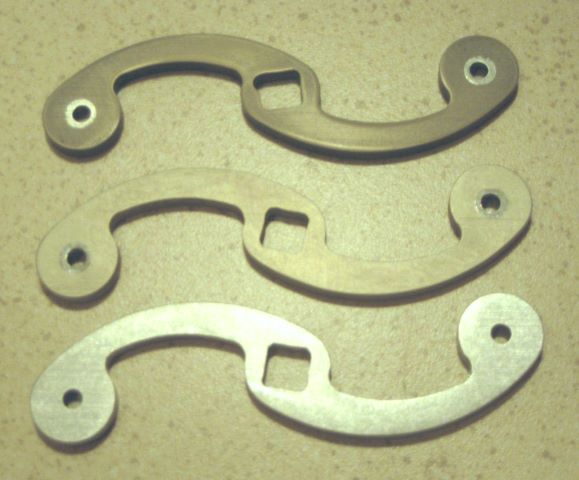
The first part, an S-crank, came out wrong. It was much darker than what I got with the first reel (May 4, 2010 blog entry).
So what went wrong? My acid solution was old, saved from last May. But it was stored in a well sealed polypropylene jar, and I would not expect sulfuric acid to deteriorate. The more likely problem is that the solution was cold; it had been sitting in my garage (~40F). I am pretty sure that this was the cause, since I noted that the anode to cathode voltage drop was unusually high during the process.
So I mixed a new acid-water solution, since I was too impatient to do a series of trials to isolate the cause. This time, with room temperature solution, the voltage drop was normal and the coating was much lighter.

Top: dark part, anodized in old, cold solution
Middle: correct part, new solution at room temperature
Bottom: not yet anodized
The top part has a machining mistake, note the square hole. I will use it as a replacement for the less well shaped crank of my first reel, after I strip the anodize and re-coat.

The properly anodized crank (middle) is less reflective than an uncoated part.  If I wanted a bright, shiny reel I would probably have to go to a professional metal finisher.

Update March 18, 2011: When I did my first anodizing (May 4, 2010) it was spring and indoor temperatures were at least 68 deg F. I was running 12 amp/sq ft current, and the acid solution was getting warm. But all anodizing looked OK. I have gone back and read Ron Newman’s instructions again, and can now see that temperature control is important.


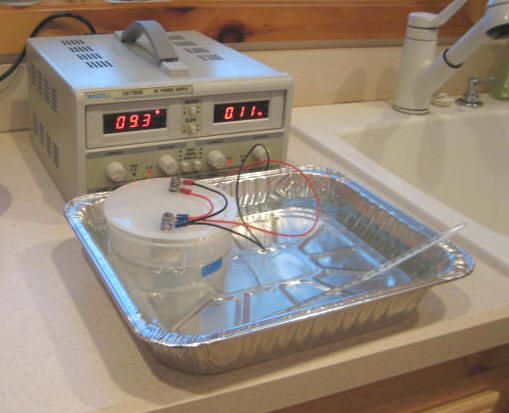
A problem with my small anodizing cells is that they have little thermal mass. So I am now putting the cell in a tray of water, and monitoring the water temperature. I add some warmer or colder water when out of range 65 to 70 F. Also, I have cut the anodizing current from 12 to 6 amps/sq ft, so heating is less. Newman says this should produce better color as well.


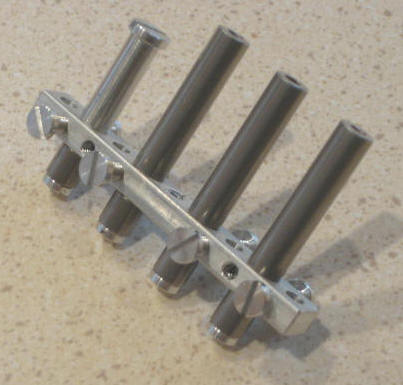
There are 6 main aluminum parts in my reel: two rings, two spool ends, crank, and foot. But there are also 24 small parts, pillars and screws. These are too small to fiddle with individually, so I made this aluminum bar to hold them while anodizing all together. Of course the bar becomes anodized, and could be an insulator for the next batch. So I strip it with lye between batches.

Posted in Anodizing/Plating | 4 Comments

Metal Finishing

When I made my first reel, I used wet/dry sandpaper to remove tool marks on the aluminum parts. On lathe parts such as rings and spool ends, I started with 320 grit and progressed through 600 and 1200 and ended with 2000 grit. Mill parts such as feet have coarser tool marks, so I started with 180 grit. Some liquid is needed to keep the paper from filling up with aluminum particles, and it seems to me that water is about as good as sewing machine oil or kerosene. When done sanding, I buffed with “tripoli, cut and color” and then had very shiny parts. A highly reflective reel is not necessarily a good thing to carry on a trout stream; I found that anodizing reduced the shine (see post of May 4, 2010).

In making a group of 5 reels, I wanted a faster way to get to the end state. So I bought a Lyman vibratory tumbler that I had read about on Michael Hackney’s forum. This tumbler (Lyman 1200 Pro Turbo Tumbler) was designed to clean brass casings when reloading ammunition, and is widely available in e-commerce.
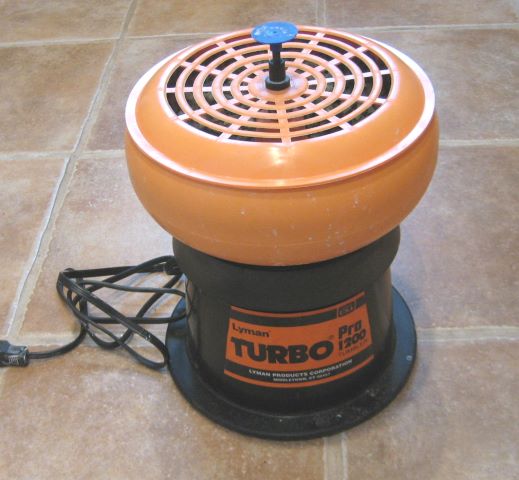
For media I bought “1/4 inch plastic pyramids” from the jewelry supplier Contenti.  These come in medium and extra fine grits; I tried both. The largest part that I have to tumble is a ring of about 3.1 inch diameter. I do these one at a time because two or more in the basin will ride up against each other. I found the tumbling action to be satisfactory for this ring, but if you had a 4 inch ring for a salmon reel, I think it might wedge. I tumble 5 or 6 cranks or feet all at the same time. I fill the tumbler basin about 1/2 full of pyramids and add  1/2 cup water. After tumbling a load, I rinse the media to remove debris. Lathe parts get a uniform matte finish in about 2 hours. Milled parts need sanding with 180 grit paper before tumbling, or else it takes forever to remove tool marks.

The last photo here shows 4 tumbled reel feet. All were tumbled with the medium grit pyramids, and the two on the right got further tumbling with extra fine. It is a barely detectable improvement. The two outside feet were buffed with tripoli, another very small improvement.
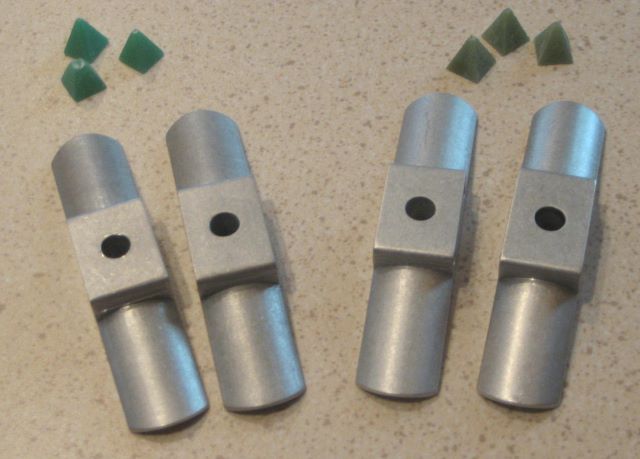
I will use the fine pyramids on all my parts, since I have them. But doing it over again I would not buy the extra fine grit.  I am satisfied with the uniform matte finish.  If you are doing just one reel at a time, don’t bother buying a tumbler.

If you want to use more than one media with the Lyman 1200 tumbler, you can buy an extra basin as P/N 7631323.

Regarding buffing: I do this with a 6 inch wheel mounted on my bench grinder. It is easy to get way too much compound in the wheel, and then black deposits are left on your parts. Eastwood sells a “buff rake” that helps restore the wheel condition; you can find this on Ebay or Amazon. I bought some 2 and 4 inch buffing wheels thinking that I could use them on my Sherline lathe (2300 rpm max.), but it turns out that the surface speed is not high enough.

Update (15 March 2011): After anodizing a couple parts, I was not happy with the appearance. So I decided to try to get a shinier surface. I bought 5 lb. of walnut shell and 1 lb. of rouge from Rock Shed.

I put 2.5 lb. of walnut shell in my extra tumbler bowl, and added about 1/3 cup of rouge, which was probably more than enough. After 24 hours of vibration, the parts had a much finer finish.
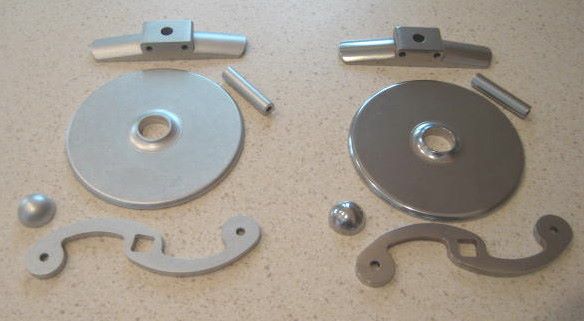
Left: parts after tumble with pyramids. Right: after additional tumble in walnut shells.

They are perhaps too shiny at this point, but I know that anodizing will tone them down. So the recipe for aluminum finishing is
1. Sand to remove all tool marks. 320 grit is probably fine enough.
2. Tumble (vibratory) with plastic pyramids 2 to 4 hours.
3. Tumble with walnut shell and rouge for 24 hours.

The rings of my reel are about 3.1 inch diameter. They tumbled OK in the plastic pyramids, but with the walnut media they continually struck the bowl and made a lot of noise. I would now say that the Lyman 1200 is too small for parts of this size, but OK for foot, spool end, crank, etc. Larger tumblers are available. Fortunately, it is not too difficult to finish round rings by hand; chuck on lathe and apply the several sandpaper grades.

Tip: Before putting pillars (or other parts with small holes) in the tumbler, plug the holes with screws. This will save much time, by keeping walnut shells out.

Update (8 March 2012): My procedure continues to evolve. For the aluminum parts of my raised pillar “aluminum frame reel”, I proceed as follows.
1. Machine the part, making the finishing pass just 0.001 inch. This minimizes tool marks because there is little vibration of the mill/lathe frame. I machine without lubricants/coolant, so the freshly machined part is quite has no oil to interfere with anodizing.
2. Wet sand with 180, then 320 grit and water. For the circular faces of end plates, do wet sanding on the lathe.
3. Tumble 2 hours with medium grit plastic pyramids, then 2 hours with extra fine grit.
4. Wet sand with 1200, then 2000 grit, then with a 3M Trizact pad (3000 grit). This replaces the walnut shell and rouge tumble, and takes much less time. I found that the rouge was carrying over into my anodizing solution, despite careful cleaning. And walnut shell alone is ineffective. I have also left out buffing; just another opportunity to work wax or grease into the surface of the part. At this point the part is not as highly reflective as before, but after anodizing it comes out the same.
5. Clean with dish detergent and then with spray degreaser.
6. Anodize.

Update 20 Nov 2012: Use enough water! Using only 1/2 cup as I mention above causes foaming. Instead, fill the tub to about half the level of the media.

Posted in Abrading, Process | Leave a comment

Raised Pillar Frame

For my 5 reel group, all parts have been machined for 4 reels. These have round rings and side plates, as shown in the photo that is presently the header of this blog. For the 5th reel, I wanted to do something different, so I have altered the rings to make a raised pillar design.

Fabrication of the ring starts with a slice of 6061 aluminum tube stock. Here it is being roughly sized on the mill. While still in the 4 jaw chuck, I will improve the surfaces on the lathe.

Now drill and counterbore holes for the pillar screws.

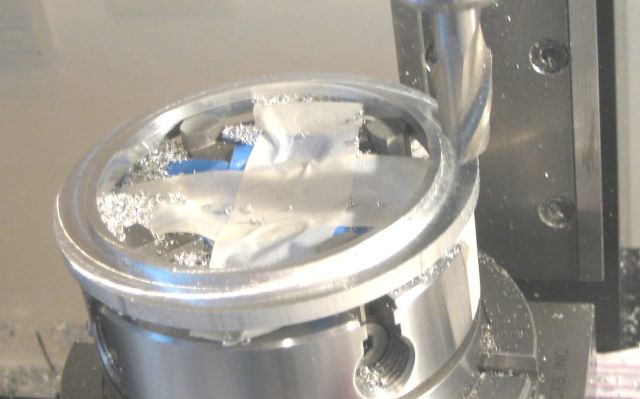
As the flange is cut away, the ring becomes much more compliant. So before cutting, I screw the ring to a piece of tool plate.

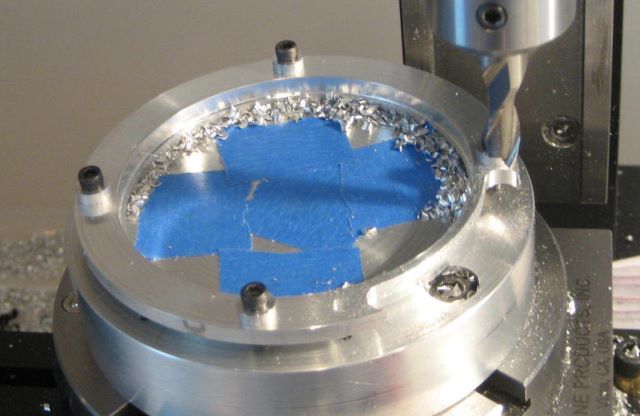
Here is the ring with the flange mostly cut away.

My round tool plate was not large enough to hold the ring while rounding off the lugs, so I made a new fixture for this. It holds the ring by 2 screws.

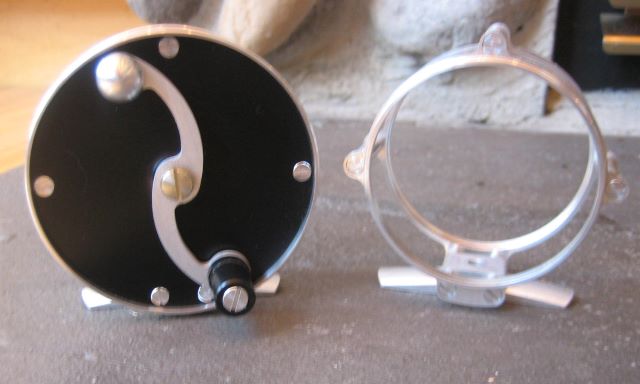
Here is the the raised pillar frame, compared to a round reel that uses the same spool.  I will make black Delrin side plates to press into the rings.

Posted in Frame, Reel Parts | 1 Comment

Progress Report #1

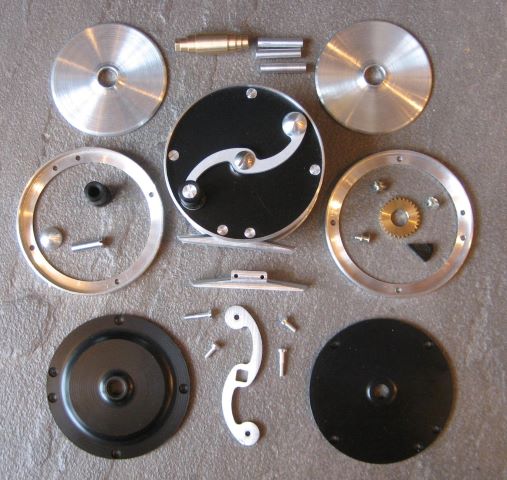
I am working on a group of 5 reels, and have enough parts done to dry fit them. Here is an illustration. Still have to make 2 nickel silver parts (crank screw, click end bearing cap) and the wire pawl springs. The aluminum parts here are not yet finished; still have to sand and anodize.

Posted in My Reels | 2 Comments