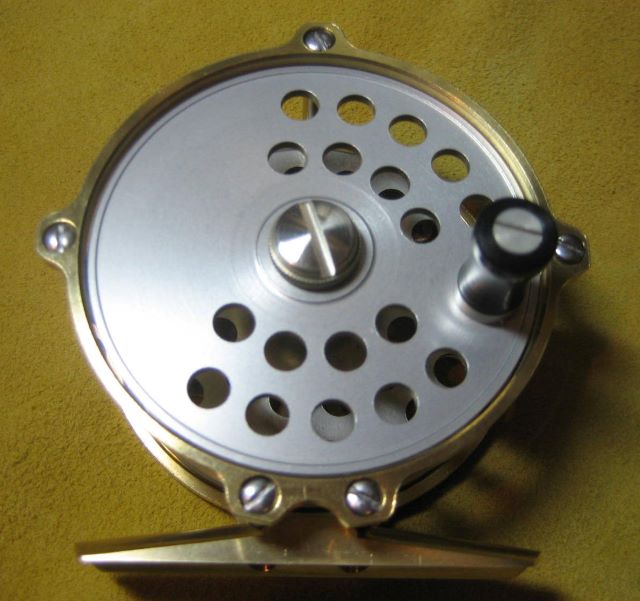
Meek 55

Local guide Sam collects and fishes Meek reels.

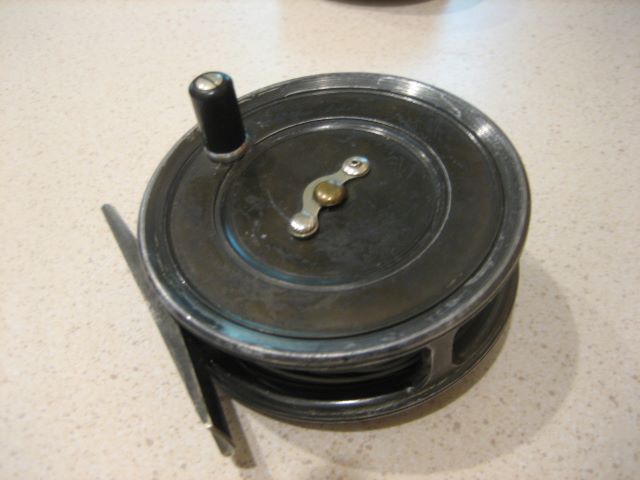
This is model 55. It is 3 1/8 diameter and somewhat more than 1 inch wide.

I believe that this is what is called a “leaded” finish.

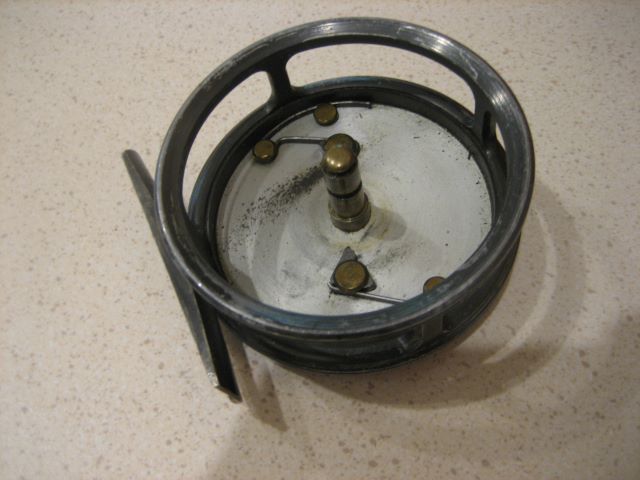
A latch bar pivots to allow spool removal.

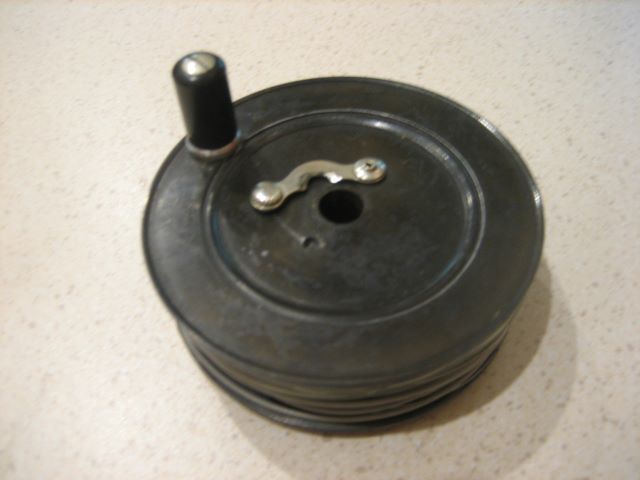
The inscription on the back says “Meek No 55, made by The Norton Mfg Co, Bristol Conn USA”.

Posted in Classic Reels | Leave a comment

Brass Frame Reel


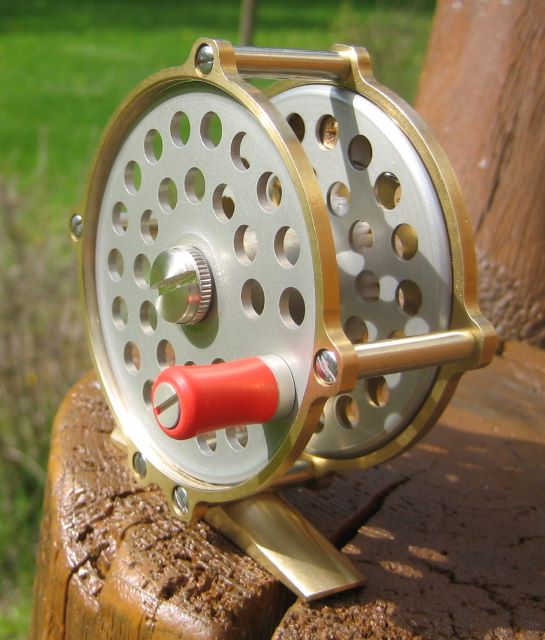
This is my new model for 2014. It was designed to hold a WF5F and 60 yards backing.

It weighs 5.1 ounces. Had the frame been aluminum, the weight would be less than 3 ounces.

The spool is still aluminum, to minimize rotating inertia. There is no counter weight, but the knob pin is aluminum for minimal unbalance.

Inside view showing clicker.

Update 7 Nov 2014: A second example of this design incorporate a “counterweight” for the knob.

Posted in My Reels | 5 Comments

Precision Washer

For my next reel design, I need a washer 5/16 inch OD, 1/8 inch ID, and .010 inch thick. I have had a similar part in past designs, and tried to make it by parting off the thin washer from a drilled rod. This is not a satisfactory method. I had trouble getting the thickness right, and the burr around the center hole was difficult to remove. The problem is that a tiny part is difficult to hold while working.

To solve the thickness problem, I have bought some .010 thick brass shim stock. I start by cutting a triangle of material using tin snips.

Here the material triangle is resting on part of the fixture in the next photo.

This fixture firmly clamps the triangle while I put in a center hole.

The best way to make the hole seems to be to plunge a center cutting end mill, going through the hole in the clamp plate.

The next fixture (shown here with the final washer) holds the material by its center hole.

I first cut the OD using my mill and rotary table, then move to the lathe to file away the burr.

Posted in Work Holding | 2 Comments

Nickel Electroplate

I was interested in nickel plating for two reasons. First, it might be a good finishing process for brass, bronze, or steel reel parts. Second, a rodmaker friend asked me if I knew a way to build up the diameter of a nickel silver ferrule that had worn and now had a loose fit.

I did the usual research on the internet and found that there are many things to consider. The plating solution must have dissolved nickel salts, but also brighteners, and other chemicals to ensure that there is no delamination. I ended up buying “Bright Nickel Electrolytic Plating Solution” manufactured by Krohn and sold by jeweler supply houses.

To prepare the parts, I also bought “Tivaclean Cleaning Concentrate” by Krohn. You can use this to “electroclean” by making the article to be plated the cathode of a cell run at 5 volts in hot cleaner solution. Cleaning should take just a few seconds.

Here is my plating cell. It has a stainless steel anode. The cathode (to be plated) is just a brass rod for this trial.

The plated rod has a brilliant finish.
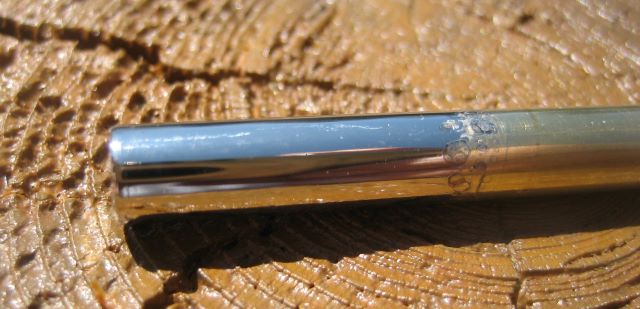
I ran the plating process for one half hour at .09 amps on the rod surface area of 0.8 square inches. This is a current density of about 16 amp/square foot. My measurements showed the diameter to increase from .2501 inch (bare brass) to .2510 inch (with plating). This should be plenty for rod ferrule repair.

During plating at constant current, the cell voltage started at 3.0 volts and gradually fell to 2.4 volts.

Following is an electrochemistry calculation regarding plating thickness. Nickel is element 28 and has a molecular weight of 58.7 . Its density is 0.322 lbm/cubic inch, and it can have valence of 2, 3, or 4 in chemical reactions. Consider plating .0005 inch of nickel onto a rod ferrule with surface area 0.8 square inches, using a plating current of .10 amp. The mass plated would be .0004 cubic inches, or .00013 lbm. I believe it should take 32 minutes to do this.

The number of electrons pushed through the wires is .10 coulomb/second * 1920 seconds * 6.25e18 electrons/coulomb = 1.2e21 electrons.

The number of nickel atoms in the plating is 6.02e23 atom/gram mole * 453 gram mole/lb mole * .00013 lbm / (58.7 lbm/lb mole) = 6.0e20 atoms.

The effective valence of the nickel is 1.2e21 electrons / 6.0e20 atoms = 2 electrons/atom.

Update 21 July 2014:Yesterday I plated the male ferrules of a 3 piece, 2 tip rod that had much use and was loose. On 2 of the 3 joints I got the right amount of plating to restore a good fit. On the first tip, I applied too much plating, so it will have to abraded down. I made electrical connection to the ferrules by twisting wire around them (above the plating area) and I used a camera tripod to lower the rod sections into the plating solution.

Update 2 June 2025: This Youtube shows how to make your own plating solution, all you need is some sheet nickel. https://www.youtube.com/watch?app=desktop&v=G-PtnwtOR24

Posted in Anodizing/Plating | 2 Comments

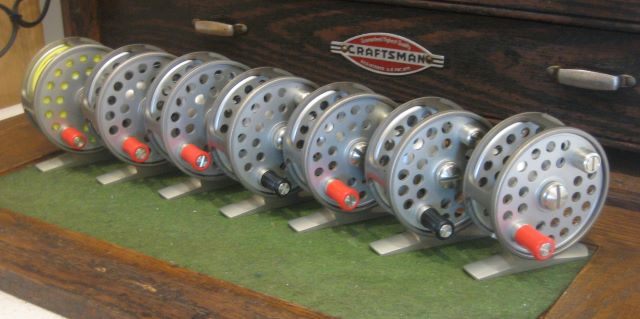
One Winter’s Production


A mix of sizes 2, 3, 4.
Now I am ready to prototype next winter’s model.

Posted in My Reels | 4 Comments

Trout Opener 2014

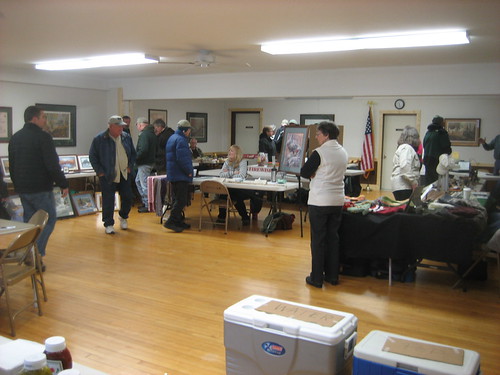
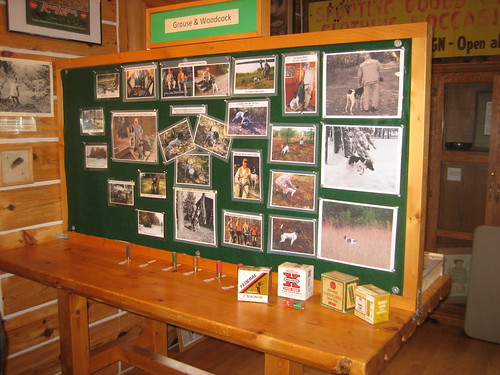
Yesterday was Opening Day, and the occasion for one of the three annual events in Lovells. Our Historical Society is the organizer. Here is a craft show in the Township Hall.

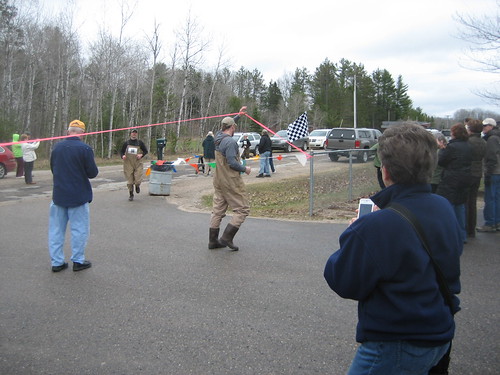
This is the finish of the “Leaky Wader Race”.

Also on the Township grounds is the Museum of Trout Fishing History. This is a picture from some summer past; yesterday was cloudy and spitting snow.

Several new displays in the museum consider local hunting.

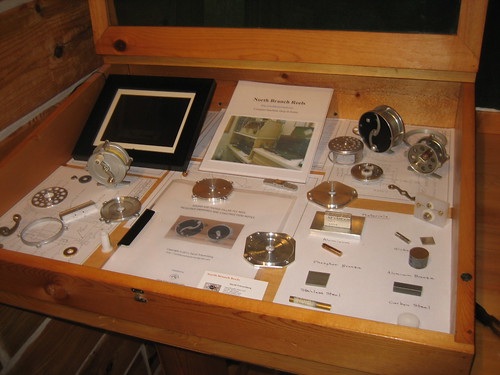
There is also a collection of antique fishing reels.

And one display that I prepared.

Posted in Uncategorized | Leave a comment

Rotary Indexer

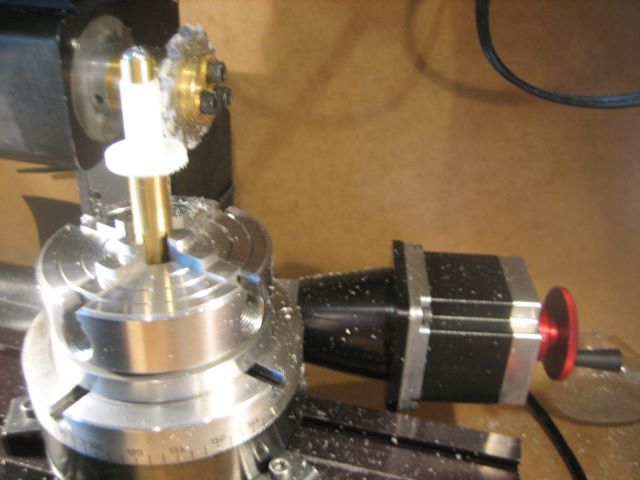
I recently bought Sherline P/N 8700, “CNC Rotary Indexer”. It consists of three units. The first is the standard 4 inch rotary table, but with a stepper motor attached. Here you see it set up to cut teeth on a ratchet.

The second part is a keypad/motor driver.

The third part is a 24 volt, 1 amp power supply (wall plug hanger).

To set up this system to index 33 equally spaced teeth, I only had to tell it to enter “division” mode and that there would be 33 divisions. After that, one key press would cause an advance of 10.909 degrees. This saved time, compared to manually cranking the angles. I also expect to use it when perforating (porting) reel frames and spools.

But the real reason that I bought it was to help with the tedious task of “hogging” out waste material on one piece frames and spools. When I do the rough hollowing out of a reel frame, I use 20 steps (.050 inch each) in the Z direction, and 4 radial positions for each Z step. Then at each of these 80 locations, I have to turn the rotary table crank 72 times, for a total of 5760 revolutions. It’s a recipe for carpal tunnel.

Update 26 May 2014: Using the indexer to remove waste material from a spool; rotation angle = 360 degrees.

Posted in Alignment, Milling, Ratchet/Gear | 2 Comments

Multi-Anvil Micrometer

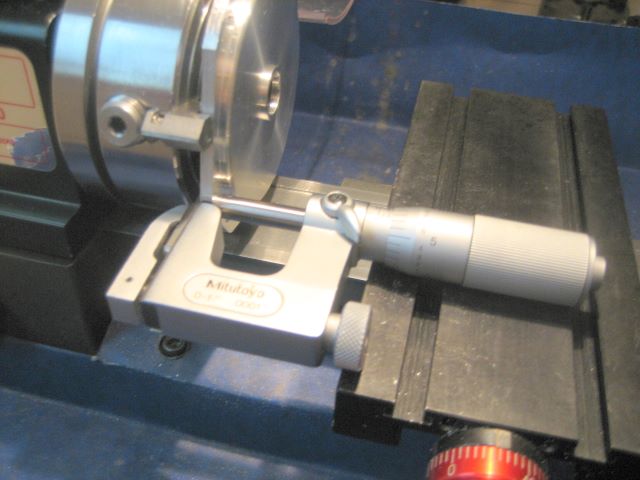
I recently became aware of this type of micrometer, and had to get one. It came with two anvils, one flat and the other a round pin.

This is a Mitutoyo 117-107. The equivalent Starrett is model 220.

I bought it so that I could measure the thickness of a reel end plate without removing the plate from the chuck. The flat anvil fits into places that are too narrow for a standard micrometer, or even the jaws of a dial caliper.

The pin anvil measures the wall thickness of a tube.

Posted in Measuring | 3 Comments

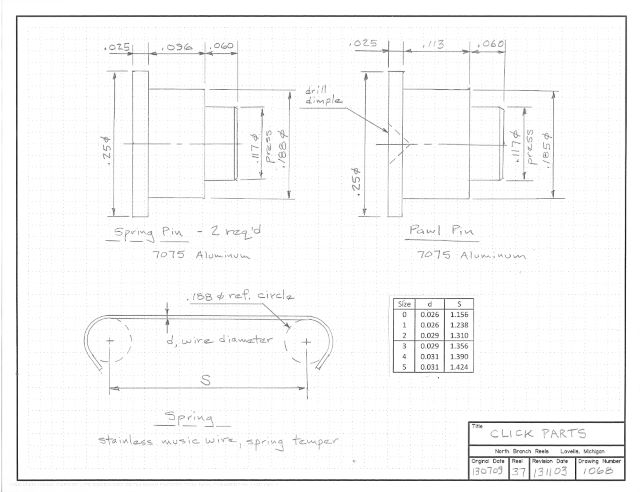
Reel 37 Click Hardware

This is the last of the “Reel 37” drawings.

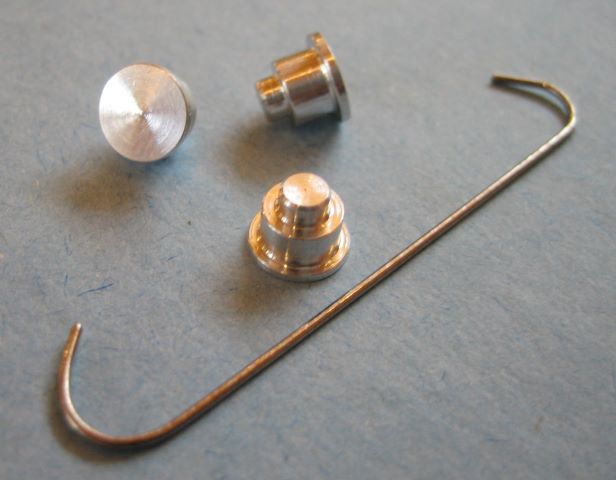
A drill point dimple helps to distinguish the pawl pin from the two spring pins.

The spring is easily bent with round nose pliers.

Posted in Click, Plans, Spring | 2 Comments

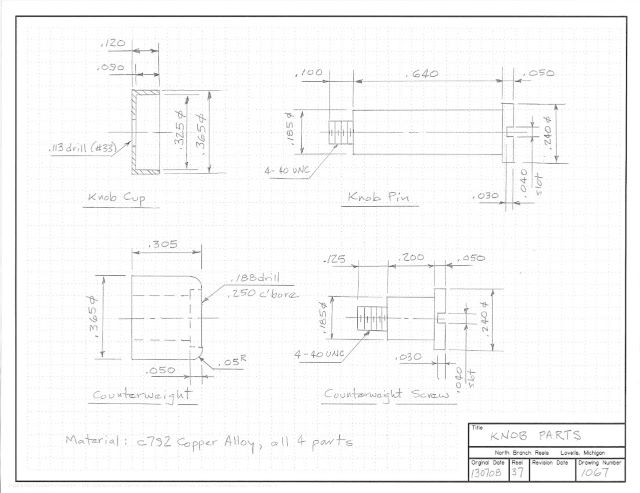
Reel 37 Crank Hardware

These parts are all made from c792 nickel silver, a free machining alloy.

The “cup” keeps tippet from getting wound around the knob pin.

Posted in Crank, Plans | Leave a comment